Real Estate in Serbia: What Foreign Buyers Need to Know in 2026
Serbia's property market has moved decisively out of the "undiscovered" category. Prices in Belgrade and Novi Sad have approximately doubled in nominal terms over the past decade, transaction volumes remain substantial, and foreign buyer interest — from Western Europe, North America, and increasingly the Middle East — has become a consistent feature of the market rather than a novelty.
What has not changed is Serbia's fundamental position relative to Western real estate markets. Even at current prices, Belgrade offers property values well below comparable European capitals, rental yields that outperform most Western markets, a clear legal pathway for foreign ownership in most categories, and a connection between property purchase and residency eligibility that no minimum investment threshold complicates.
This guide covers the 2026 market accurately: prices by city, what foreign buyers can and cannot own, the tax and cost structure, the residency connection, the rental income picture, and the risks that are genuinely worth knowing before you commit.
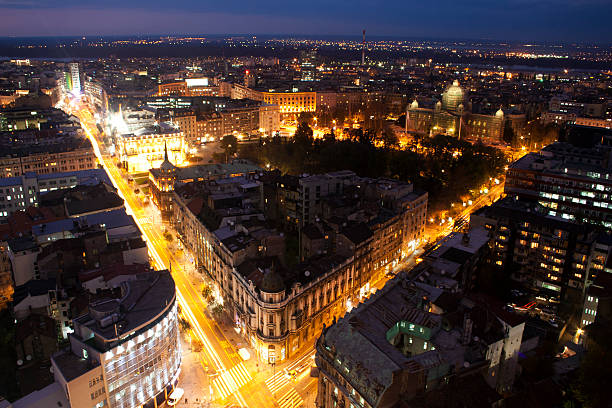
The Market in 2026: Where Prices Actually Stand
The headline figures from the original version of this page are no longer accurate. Here is where the market stands based on verified transaction data from the Republic Geodetic Authority and leading Serbian real estate platforms, updated through early 2026.
Belgrade remains the most expensive and most liquid market in Serbia. New-build apartments transacted at a median of approximately €2,517 per square metre in recent quarters, with resale properties at approximately €2,560 per square metre. The gap between new-build and resale is notably narrow in Belgrade — typically 10 to 20% — which pushes many buyers toward well-located existing stock rather than new developments on the urban fringe.
Within Belgrade, prices vary significantly by neighbourhood. Prime central districts — Stari Grad, Vračar, and Dorćol — command €3,000–4,600 per square metre for quality properties. Novi Beograd, which offers larger and newer apartments in planned blocks near the waterfront and office clusters, averages approximately €2,894 per square metre. The Belgrade Waterfront development, a landmark mixed-use project along the Sava, trades at an average of approximately €5,500 per square metre — more than double the city median.
Novi Sad is the second most active market, with new-build units transacting at approximately €2,256 per square metre and resale apartments at a similar level. Central Novi Sad neighbourhoods — Liman, Grbavica — are approaching Belgrade pricing for comparable products. Outer areas offer meaningfully lower entry points.
Niš offers the most affordable major-city entry point. Prices for quality apartments in central locations run approximately €1,200–1,500 per square metre. New-build prices in Niš have risen by approximately 60% over the past five years, but the absolute level remains well below Belgrade and Novi Sad.
Secondary and resort markets include Zlatibor, Kopaonik, and spa towns such as Vrnjačka Banja, where tourism demand drives pricing that can approach or exceed Novi Sad levels for quality properties in prime locations.
The overall market direction for 2026, according to leading Serbian real estate agencies and independent analysts, is moderate price growth of approximately 3 to 6%, replacing the double-digit growth seen in 2021 to 2024. The market is entering a more rational phase — less competitive urgency for buyers, more room to negotiate, but no expectation of price corrections given the structural supply constraints in prime locations.
What Foreign Buyers Can Own
Serbia operates a reciprocity-based system for foreign property ownership. Citizens of countries with a valid reciprocity agreement with Serbia can purchase most categories of residential and commercial real estate. This covers nationals of the United States, Canada, United Kingdom, Australia, and EU member states, among many others.
There are two significant restrictions regardless of nationality. First, foreigners cannot directly own agricultural land. A Serbian-incorporated company can hold agricultural land regardless of its ownership nationality, but direct personal ownership is not permitted. Second, property in protected zones — including certain national park areas — carries additional restrictions that require case-by-case legal verification.
For the residential and commercial property categories that constitute the vast majority of transactions, there are no ownership caps, no percentage limits on foreign ownership within a building, and no screening or approval mechanisms for foreign buyers beyond the standard legal process.
The Purchase Cost Structure
Understanding the full cost of acquisition — not just the headline price — is essential for accurate budgeting.
Property Transfer Tax (resale properties): 2.5% of the purchase price, payable within 15 days of completion. This is notably low by European standards.
VAT (new-build properties): New-build residential properties are subject to 10% VAT, which is typically included in the developer's listed price rather than added on top. New-build purchases do not attract the 2.5% transfer tax.
Notary fees: Notarisation of the purchase agreement is legally required. Fees are calculated on a sliding scale based on the transaction value and are capped at approximately €3,030 plus VAT. Non-Serbian speakers will typically require a bilingual agreement or certified translation, which adds a modest additional cost.
Cadastre registration: Registering ownership in the Republic Geodetic Authority (RGZ) — Serbia's land registry — involves fees that are generally modest, typically a few hundred euros depending on the property value.
Legal representation: Engaging an independent property lawyer is strongly advisable for foreign buyers. Legal fees typically range from approximately 0.05% to 1.5% of the transaction value depending on complexity.
Real estate agent commission: Where an agent is involved, commission is typically around 2% plus VAT, usually paid by one or both parties as negotiated.
Total closing costs: For resale purchases, total additional costs including transfer tax, notary, registration, and legal fees typically fall in the range of 5 to 8% of the purchase price. For new-build purchases where VAT is already included in the listed price, additional closing costs outside the headline price typically run 2 to 5%.
Annual property tax: An ongoing holding cost that is often omitted in guides aimed at foreign buyers. Serbia levies an annual property tax at a maximum rate of 0.4% of assessed property value for residential properties and 0.8% for commercial properties. At Serbian property values, this is a modest cost — but it is a real one.
Capital Gains Tax: The Detail That Matters
The capital gains tax picture in Serbia is one of the features that attracts longer-term property investors, but it requires careful attention to the distinctions between buyer categories.
Resident private individuals: Capital gains on property sales are taxed at 15% of the net gain (selling price minus acquisition price, adjusted for allowable costs). After holding a property for ten years or more, the capital gains tax exemption applies — the sale is tax-free regardless of the gain.
Non-resident private individuals: The 15% capital gains tax rate applies. The ten-year holding exemption is also available to non-resident individual sellers. Non-residents are required to appoint a fiscal representative in Serbia who submits the tax return within 30 days of the sale.
Non-resident corporate entities: The treatment is different and less favourable. Capital gains realised by non-resident companies from Serbian property disposals are subject to 20% withholding tax, and the ten-year exemption does not apply to corporate buyers. This is an important structural consideration for anyone considering purchasing through a foreign company rather than in their personal name.
Rental income tax: Property owners generating rental income in Serbia are taxed at an effective rate of approximately 15% of gross rent, after a 25% standardised expense deduction is applied to the gross rental income.
Rental Yields: What the Market Looks Like for Investors
Serbia's rental market has developed considerably alongside rising property values, and yields remain competitive by European standards.
Gross rental yields for residential properties in Serbia's primary urban markets average approximately 5.57% nationally. Belgrade demonstrates stronger investment performance, with gross yields averaging approximately 6.35%, compared to Novi Sad at approximately 4.79%. Asking rents in Belgrade range from approximately €7 to €13 per square metre per month depending on location and quality, with studios and one-bedroom apartments typically generating the strongest yield-to-price ratios.
Rental demand in Belgrade and Novi Sad is underpinned year-round by the presence of international companies, a large IT sector employing well-paid professionals, diplomatic missions, universities, and a growing expatriate population. This demand profile is relatively resilient compared to markets that depend heavily on short-term tourism.
The short-term rental market — Airbnb and similar platforms — is active in central Belgrade and has produced strong returns for some investors, though it requires active management and is subject to evolving local regulations.
Property Types: What the Market Actually Offers
The Serbian property market is dominated by apartments. Detached houses and villas exist but represent a much smaller share of transactions, particularly in urban areas. The apartment-heavy nature of the market reflects both the urbanisation patterns of post-war Yugoslav development and the continuing preference for city-centre living among both domestic buyers and foreign investors.
New-build apartments offer modern specifications, energy efficiency, and typically a ten-year structural warranty. Developers in Belgrade and Novi Sad have raised build quality considerably over the past decade. Prices are higher than equivalent resale stock, and the 10% VAT is included in the listed price.
Resale apartments represent the majority of market transactions. They range from well-maintained properties in established neighbourhoods to older stock requiring renovation. For foreign buyers, resale properties in prime central locations often offer better value than new-builds on the urban fringe. The price gap between new-build and resale in Belgrade is typically 10 to 20%.
Understanding Serbian apartment terminology is worth a brief mention, as it causes confusion for many international buyers. A "jednosoban" (one-room) apartment refers to a studio or bedsit, not a one-bedroom. A "dvosoban" (two-room) apartment is what most English speakers would call a one-bedroom — a living room plus one bedroom. A "trosoban" (three-room) apartment has a living room plus two bedrooms. Always clarify the floor plan and room layout, not just the number.
A Risk That Deserves Honest Coverage: Unauthorised Constructions
This is one of the most important practical risks for foreign buyers in Serbia and is frequently underemphasised in property guides aimed at international audiences.
Serbia has a documented history of unauthorised constructions — buildings or extensions built without proper permits that are not correctly registered in the Republic Geodetic Authority. Purchasing a property with legalisation issues creates significant legal exposure, including potential difficulties in resale, inability to obtain financing, or complications with residency applications linked to the property.
Serbian law has provided several legalisation windows for unauthorised structures, and many properties have been regularised — but not all. The status of any property under consideration must be verified against the RGZ cadastre before any commitment is made. A property's status in the cadastre is the authoritative record — what a seller or agent says about legal status is secondary to what the official registry shows.
This is one of the most concrete reasons why independent legal due diligence, conducted by a qualified Serbian property lawyer acting for the buyer rather than the transaction, is not optional for foreign buyers.
Property Ownership and Residency
Owning residential property in Serbia qualifies as a basis for applying for a temporary residence permit. There is no minimum purchase price required — the property simply needs to be legally residential and properly registered in the buyer's name in the cadastre.
It is important to be precise about what this means and what it does not mean. Property ownership establishes eligibility to apply for temporary residence; it does not guarantee approval. Serbian authorities assess applications on the legal basis presented, and the property must genuinely be a legitimate residence rather than a nominal purchase used solely for immigration purposes.
Serbia does not operate a formal golden visa programme in the sense of a structured investment-for-residency scheme with guaranteed timelines. The connection between property ownership and residency operates through the standard temporary residence permit framework, which involves annual or multi-year permits renewable subject to continued eligibility.
After three years of continuous lawful temporary residence — maintained through annual renewals — permanent residency becomes available. Citizenship by naturalisation has additional requirements beyond permanent residence, including demonstrating meaningful integration and ties to Serbia, and has its own separate timeline and criteria.
The Market Outlook: 2026 and Beyond
The consensus among Serbian real estate analysts and agencies entering 2026 is one of moderate optimism. Price growth is expected in the 3 to 6% range nationally, with Belgrade at the higher end. Supply constraints in prime central locations — limited new construction inventory in established neighbourhoods — continue to support values for quality properties.
The medium-term catalysts worth tracking include the EXPO 2027 legacy development in Surčin, which is planned to transition into a residential neighbourhood for approximately 4,500 people after the event; the early-stage planning for a Belgrade metro, which would represent the most significant urban transport infrastructure investment in the capital's modern history; and continued foreign investment interest driven by Serbia's broader economic trajectory.
The areas identified by market analysts as having the strongest near-term price growth potential include Vozdovac and Zvezdara in Belgrade — both offering good transport links and newer housing at 20 to 40% below prime central prices — and Liman and Grbavica in Novi Sad. For longer-horizon investors, Palilula in Belgrade and central Niš are frequently cited as markets where relative affordability combines with improving infrastructure.
How Relocation Serbia Works with Real Estate Clients
Real estate transactions in Serbia involve a sequence of legal, administrative, and practical steps that are navigable but require careful coordination — particularly for foreign buyers unfamiliar with Serbian legal procedures, language, and institutions.
At Relocation Serbia, we work with clients across the full property journey: understanding the market and identifying suitable areas based on individual needs and budget, coordinating with qualified legal professionals for due diligence and purchase contracts, facilitating the banking relationship required for the transaction, and connecting property acquisition with residency applications where relevant.
We do not act as a real estate agent — we are a relocation and advisory firm. Our role is to ensure that clients approach the market with accurate information, appropriate professional support, and a clear understanding of the legal and financial implications of their decisions.
For clients at the early exploration stage, a consultation is the right starting point. Serbia's property market offers genuine opportunity, but the specifics — which city, which property type, which legal structure, how it connects to residency goals — depend entirely on individual circumstances.
Frequently asked questions
Can foreigners buy property in Serbia?
Yes, in most categories. Citizens of countries with a reciprocity agreement with Serbia — which includes the United States, Canada, United Kingdom, Australia, and EU member states — can purchase residential and commercial property. Direct ownership of agricultural land and property in certain protected zones is not permitted for foreigners.
What taxes and costs should I budget for when buying property?
For resale properties: 2.5% property transfer tax, notary fees, cadastre registration, and legal representation, totalling approximately 5 to 8% of the purchase price. For new-build properties: 10% VAT is typically included in the listed price, with additional closing costs of approximately 2 to 5%.
Does buying property in Serbia grant residency?
Residential property ownership qualifies as a basis for applying for a temporary residence permit in Serbia, with no minimum purchase price required. It does not guarantee approval and does not constitute a formal golden visa programme. Permanent residency becomes available after three years of continuous lawful temporary residence.
What is the risk of unauthorised constructions?
A documented risk in the Serbian market. Properties built without permits or not correctly registered in the Republic Geodetic Authority can create legal complications for buyers. Cadastre verification and independent legal due diligence before any purchase commitment are strongly advisable.
What are current apartment prices in Belgrade and Novi Sad?
As of early 2026, new-build apartments in Belgrade transact at a median of approximately €2,517 per square metre, with resale at approximately €2,560 per square metre. In Novi Sad, new-build median prices are approximately €2,256 per square metre. Prime central Belgrade locations command €3,000–4,600 per square metre.
What is the capital gains tax on property in Serbia?
Individual sellers pay 15% on net gains. After holding a property for ten years as an individual, the gain is entirely exempt from capital gains tax. Non-resident corporate entities face a 20% withholding tax with no ten-year exemption available.
Is there an annual property tax in Serbia?
Yes. The annual property tax rate for residential property is a maximum of 0.4% of assessed market value. For commercial property, the maximum rate is 0.8%. The assessed value is determined by the tax authorities and may differ from the purchase price.
What rental yields can investors expect?
Gross rental yields in Serbia's primary markets average approximately 5.57% nationally. Belgrade averages approximately 6.35% gross, with stronger performance in central locations and smaller apartments. Rental income is effectively taxed at around 15% of gross rent after the standardised expense deduction.
The information in this article is for general informational purposes only and does not constitute legal, financial, tax, or investment advice. Property regulations, tax rates, and market conditions are subject to change. Relocation Serbia recommends that all individuals obtain independent legal and financial advice relevant to their personal circumstances before making any property decisions in Serbia.